The Alchemy of Perception: How Generative AI and Computer Vision Are Redefining Reality Itself
Imagine standing at the edge of a vast, uncharted wilderness where the boundaries between the physical and the digital blur into a seamless tapestry of light and shadow. This is the frontier where generative artificial intelligence and computer vision converge, not merely to observe the world but to reinterpret it, to breathe life into pixels, and to redefine what it means to perceive. Here, machines do not just see—they understand, they create, and they dream in ways that were once the sole province of human imagination. The alchemy of perception has begun, and it is transforming reality itself.
The Eyes of the Machine: Beyond Mere Observation
For decades, computer vision was confined to the rigid, rule-bound task of recognizing patterns—identifying faces in a crowd, detecting objects on an assembly line, or parsing the edges of a road for autonomous vehicles. It was a world of static snapshots, where machines processed images with the cold precision of a calculator. But the advent of generative AI has shattered these limitations, infusing vision with something far more profound: the ability to imagine.
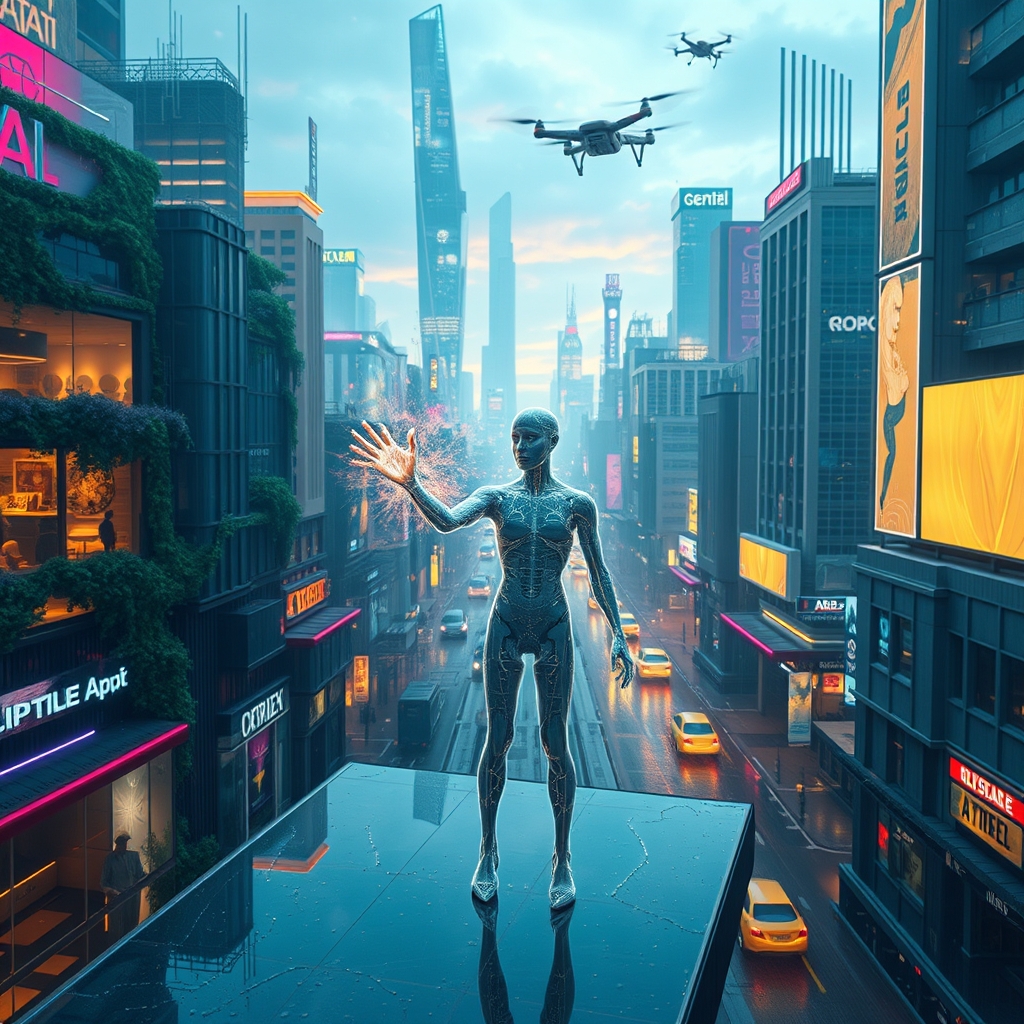
Today, neural networks do not just classify images; they generate them. Models like Stable Diffusion, DALL·E, and MidJourney have demonstrated an almost eerie capacity to conjure hyper-realistic scenes from the barest whispers of text. A prompt as simple as “a cyberpunk city at dusk, neon reflections on rain-slick streets” becomes a living, breathing digital metropolis, complete with intricate details that no human artist could render in a lifetime. This is not mere replication—it is creation, a form of digital genesis where algorithms become artists, architects, and storytellers.
The Neural Canvas: Where Pixels Become Poetry
At the heart of this revolution lies the neural network, a labyrinth of interconnected nodes that mimic the synaptic pathways of the human brain. But unlike their biological counterparts, these networks do not merely process information—they transform it. Through layers of convolutional filters, attention mechanisms, and diffusion processes, they deconstruct and reconstruct visual data, weaving it into something entirely new. The result is a form of synthetic perception, where the line between the real and the generated dissolves into irrelevance.
Consider the implications for fields like medicine, where generative AI can now synthesize high-resolution medical images from low-quality scans, enabling doctors to diagnose conditions with unprecedented clarity. Or in the realm of autonomous systems, where self-driving cars no longer rely solely on pre-programmed maps but dynamically generate 3D environments in real-time, anticipating obstacles before they even appear. This is not just an evolution of computer vision—it is a metamorphosis, a shift from passive observation to active, adaptive perception.
The Dance of Light and Code: How Generative AI Reimagines Vision
What happens when a machine does not just see the world but reinterprets it? The answer lies in the fusion of generative AI and predictive analytics, where algorithms do not merely capture reality but augment it. Imagine a surgeon wearing augmented reality glasses that overlay generative reconstructions of a patient’s anatomy, highlighting hidden tumors or predicting the outcome of a procedure before the first incision is made. Or an architect walking through a digital twin of a building that does not yet exist, where every beam, every shadow, is rendered in real-time by an AI that understands not just structure but aesthetics.
This is the promise of adaptive intelligence—a world where machines do not just follow instructions but collaborate with human creativity. In the hands of artists, generative AI becomes a co-creator, suggesting compositions, refining brushstrokes, or even generating entire galleries of art from a single seed of inspiration. In the realm of robotics process automation, it enables systems to adapt to unforeseen challenges, generating solutions on the fly rather than relying on rigid, pre-defined workflows. The machine is no longer a tool—it is a partner in the act of creation.
The Ethical Horizon: Navigating the New Reality
Yet, with this power comes a profound responsibility. The same technology that can generate lifesaving medical images or breathtaking works of art can also be weaponized—creating deepfakes that manipulate public opinion, generating synthetic data to deceive autonomous systems, or eroding the very notion of truth. The alchemy of perception is a double-edged sword, one that demands not just technical mastery but ethical vigilance.
This is where explainable AI becomes crucial. As generative models grow more complex, their decision-making processes can become opaque, even to their creators. To trust these systems, we must demand transparency—not just in how they generate images but in why they generate them. What biases lurk in the training data? What assumptions are embedded in the algorithms? The future of computer vision is not just about what machines can see but about what we, as a society, choose to show them.
The Unwritten Future: Where Perception Meets Possibility
We stand at the precipice of a new era, one where the act of seeing is no longer a passive experience but an active collaboration between human and machine. The fusion of generative AI and computer vision is not just redefining reality—it is expanding it, pushing the boundaries of what we can perceive, create, and understand. From the depths of quantum simulations to the heights of artistic expression, these technologies are weaving a tapestry of possibility that was once the stuff of science fiction.
But the true magic lies not in the technology itself but in how we choose to wield it. Will we use it to build a world of greater empathy, where machines help us see the invisible threads that connect us all? Or will we succumb to the allure of illusion, where reality becomes a malleable construct, shaped by the highest bidder? The alchemy of perception is not just about what machines can do—it is about what we, as a civilization, dare to imagine. And in that imagination, the future is not just seen—it is created.