
The Sky’s No Limit: How Advanced Drone Technologies Are Reshaping Industries
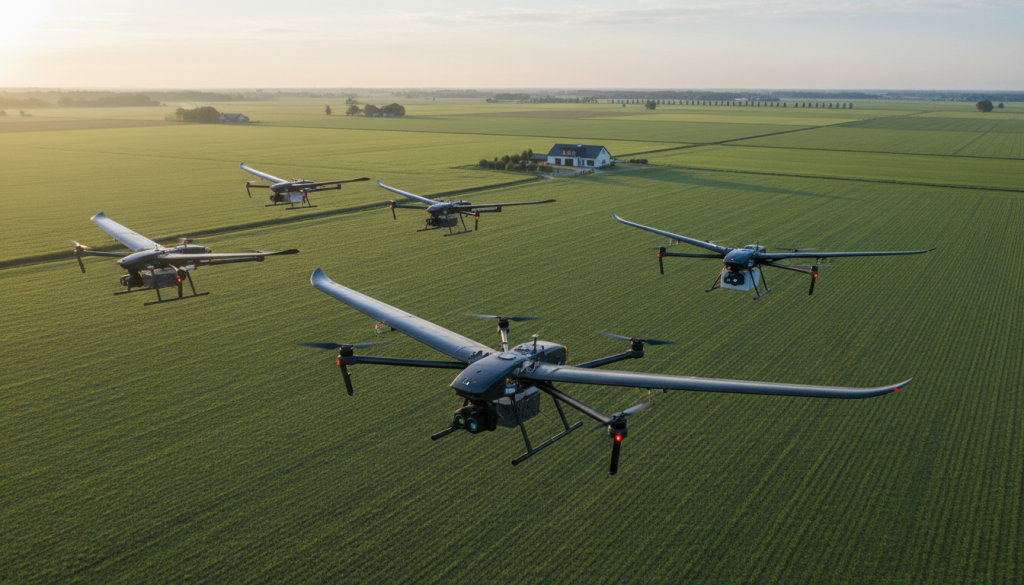
The drone revolution is no longer a futuristic concept; it’s a present-day reality rapidly transforming various sectors. From the intricacies of precision agriculture to the speed of delivery logistics, and from advanced mapping to critical infrastructure inspection, unmanned aerial vehicles (UAVs) are becoming indispensable tools. This evolution is driven by a confluence of cutting-edge technologies, including sophisticated autonomous flight systems, AI-driven navigation, and enhanced sensor capabilities. These advancements are not merely incremental improvements; they represent a paradigm shift in how we approach complex tasks, promising greater efficiency, safety, and scalability.
Precision Agriculture Takes Flight
In the realm of agriculture, drones equipped with specialized sensors are revolutionizing farming practices. Precision agriculture drones, outfitted with thermal imaging sensors and multispectral cameras, can meticulously analyze crop health, soil conditions, and irrigation needs at a granular level. This data, often gathered through photogrammetry mapping, allows farmers to identify areas of stress, disease, or nutrient deficiency long before they become visible to the naked eye. AI-driven navigation ensures these drones can cover vast fields systematically, while real-time kinematic (RTK) positioning provides centimeter-level accuracy for precise application of fertilizers and pesticides, thereby minimizing waste and environmental impact. The ability to perform these tasks autonomously significantly reduces the labor-intensive nature of traditional farming, leading to higher yields and more sustainable practices.
The Dawn of Autonomous Logistics
The dream of drone-delivered packages is rapidly becoming a reality, thanks to advancements in delivery drone logistics and autonomous flight systems. Companies are investing heavily in developing robust fleets capable of navigating complex urban environments. Obstacle avoidance technology is paramount here, ensuring safe operation amidst buildings, power lines, and other aerial traffic. Long-range telemetry and 5G connectivity are crucial for maintaining constant communication and control over extended distances. Furthermore, the development of fixed-wing VTOL (Vertical Take-Off and Landing) drones offers the best of both worlds: the agility of multirotor drones for take-off and landing, combined with the efficiency and speed of fixed-wing aircraft for longer transit flights. This combination is key to building scalable and efficient delivery networks.
Enhanced Sensing and Data Acquisition
The capabilities of drones are being dramatically expanded by sophisticated sensor technology and advanced processing. Thermal imaging sensors, for instance, are not only vital for agriculture but also for industrial inspection, enabling the detection of heat anomalies in power lines, pipelines, and buildings that could indicate potential failures. Photogrammetry mapping, powered by high-resolution cameras and precise GPS, allows for the creation of detailed 3D models of infrastructure, construction sites, and natural landscapes. The integration of edge computing on UAVs means that data processing can happen in real-time, directly on the drone, reducing latency and the need for constant, high-bandwidth data transmission. This is particularly important for AI-driven navigation and immediate decision-making in dynamic environments.
Powering the Future: Efficiency and Sustainability
The physical platforms themselves are also undergoing significant evolution. Lightweight yet incredibly strong carbon fiber airframes are becoming standard, improving flight endurance and payload capacity. Brushless motor efficiency has seen remarkable gains, contributing to longer flight times and greater reliability. Looking ahead, hydrogen-powered drones promise to revolutionize endurance and operational range, offering a sustainable alternative to battery power for heavy-lift payload applications and extended missions. These advancements in power systems and airframe design are critical for unlocking the full potential of drones in demanding applications.
Security and Control in the Skies
As drone usage proliferates, so does the need for robust security and regulatory frameworks. Remote identification systems are becoming mandatory, allowing authorities to identify drones operating in airspace, enhancing safety and security. For scenarios where unauthorized drones pose a threat, kinetic drone interception technologies are being developed. These systems offer non-destructive or destructive methods to neutralize rogue aircraft, ensuring the safety of critical infrastructure and public events. The integration of swarm intelligence is also an emerging area, enabling multiple drones to coordinate complex missions autonomously, mimicking natural phenomena like flocking birds, which can be applied to tasks ranging from search and rescue to large-scale surveillance.
The continuous innovation in autonomous flight systems, sensor technology, and propulsion methods is rapidly pushing the boundaries of what drones can achieve. From optimizing crop yields with precision agriculture to ensuring the seamless flow of goods through advanced delivery logistics, and from generating detailed 3D maps to performing critical infrastructure inspections, the impact is profound. The ongoing development in areas like AI-driven navigation, efficient airframes, and sustainable power sources, coupled with the evolving regulatory landscape for remote identification and airspace security, points towards a future where drones are not just tools, but integral components of our industrial and societal infrastructure, operating with increasing autonomy, intelligence, and responsibility.