The Invisible Spark: How Edge Computing and Quantum Cryptography Are Forging the Future of Landing Zone Autonomy
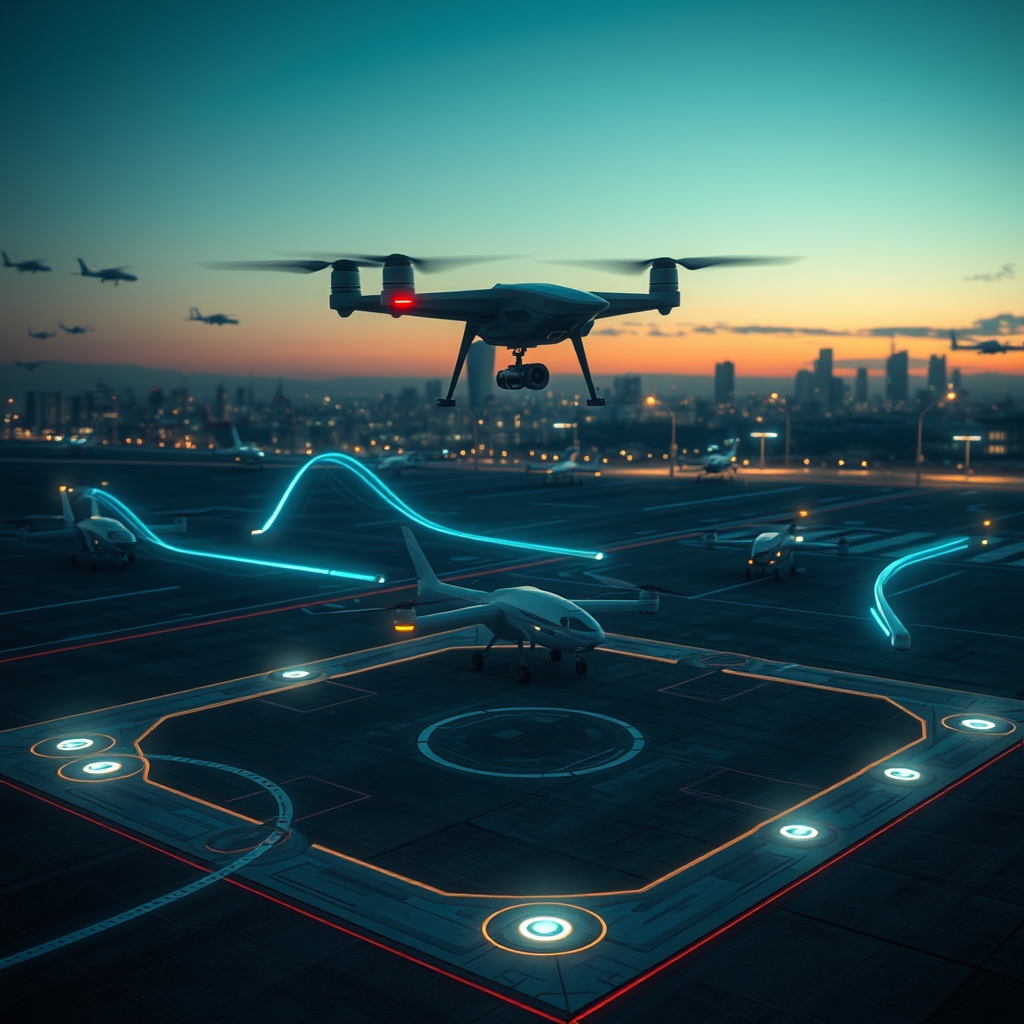
Imagine a world where the skies are not just pathways for aircraft but intricate, self-orchestrating networks of intelligence, where every landing is not just precise but a symphony of data, security, and autonomy. This is not a distant dream but an emerging reality, shaped by the confluence of edge computing and quantum cryptography. Together, these technologies are redefining what it means to land an aircraft—or any autonomous vehicle—with unparalleled accuracy, safety, and resilience.
The Edge of Autonomy
At the heart of this transformation lies edge computing, a paradigm that shifts data processing from centralized cloud servers to the very edges of the network—closer to where the data is generated. For landing zone autonomy, this means real-time decision-making capabilities that are not just fast but instantaneous. Traditional cloud computing, with its inherent latency, is ill-suited for the split-second decisions required during a landing sequence. Edge computing, however, empowers autonomous systems to analyze data on the fly, whether it’s assessing runway conditions, adjusting for wind shear, or identifying obstacles in real time.
Consider the complexity of a modern landing zone. Sensors embedded in the tarmac, drones patrolling the perimeter, and aircraft equipped with advanced avionics all generate vast amounts of data. Edge computing processes this data locally, reducing the need for constant communication with distant servers. This not only minimizes latency but also enhances reliability, as the system can continue to operate even if connectivity is compromised. The result is a landing zone that is not just smart but self-sufficient, capable of adapting to dynamic conditions without human intervention.
The Quantum Shield
Yet, with great autonomy comes great vulnerability. The more interconnected and data-driven landing zones become, the more they attract the attention of malicious actors. Cyber threats, from data breaches to spoofing attacks, pose significant risks to autonomous systems. This is where quantum cryptography enters the stage, offering a level of security that is not just robust but theoretically unbreakable.
Quantum cryptography leverages the principles of quantum mechanics to secure data transmission. Unlike classical encryption, which relies on complex mathematical algorithms, quantum cryptography uses the fundamental properties of quantum particles—such as entanglement and superposition—to create encryption keys that are inherently secure. Any attempt to intercept or eavesdrop on a quantum-encrypted communication disrupts the quantum state, immediately alerting the system to the breach. For landing zone autonomy, this means that critical data—such as navigation commands, sensor readings, and communication between aircraft and ground control—can be transmitted with absolute confidence in its integrity.
Imagine a scenario where an autonomous drone is preparing to land in a high-security zone. Quantum-encrypted signals ensure that the drone’s navigation system is impervious to spoofing attacks, where malicious actors might attempt to feed false GPS coordinates. The drone’s sensors, powered by edge computing, process real-time data from the landing zone, while quantum cryptography guarantees that this data remains tamper-proof. The result is a landing sequence that is not just autonomous but impenetrable.
The Synergy of Edge and Quantum
The true magic happens when edge computing and quantum cryptography converge. Edge computing provides the speed and local processing power needed for real-time autonomy, while quantum cryptography ensures that every piece of data—whether it’s a command from air traffic control or a sensor reading from the runway—is secure and trustworthy. This synergy creates a landing zone ecosystem that is both intelligent and resilient, capable of operating in the most challenging conditions.
For example, in a bustling urban airport where multiple autonomous aircraft are landing simultaneously, edge computing enables each aircraft to process its own data independently, reducing the risk of system-wide failures. Meanwhile, quantum cryptography secures the communication channels between aircraft, ground control, and the landing zone’s infrastructure. This combination ensures that even in high-traffic scenarios, landings remain smooth, secure, and free from interference.
The Future of Autonomous Landings
The implications of this technological marriage extend far beyond aviation. Autonomous vehicles, from delivery drones to air taxis, will rely on similar systems to navigate complex urban environments. Smart cities, with their interconnected networks of sensors and autonomous infrastructure, will depend on edge computing and quantum cryptography to ensure seamless, secure operations. Even in remote or disaster-stricken areas, where traditional infrastructure may be compromised, these technologies can enable autonomous systems to operate with minimal human oversight.
Yet, the journey is not without its challenges. The deployment of edge computing infrastructure requires significant investment in hardware and software, while quantum cryptography is still in its relative infancy, with practical implementations limited by current technological constraints. However, as these technologies mature, their integration into landing zone autonomy will become not just feasible but inevitable.
The skies of tomorrow will be shaped by systems that are not just autonomous but intelligent, not just secure but unassailable. As edge computing and quantum cryptography continue to evolve, they will redefine the boundaries of what is possible, turning the dream of fully autonomous landing zones into a tangible reality. The spark has been lit, and the future of autonomy is not just on the horizon—it is already taking flight, invisible yet unstoppable, weaving a new era of precision, security, and innovation into the very fabric of our skies.