
Wings of Tomorrow: The Convergence of Cutting-Edge Drone Technologies and the Future of Autonomous Skies
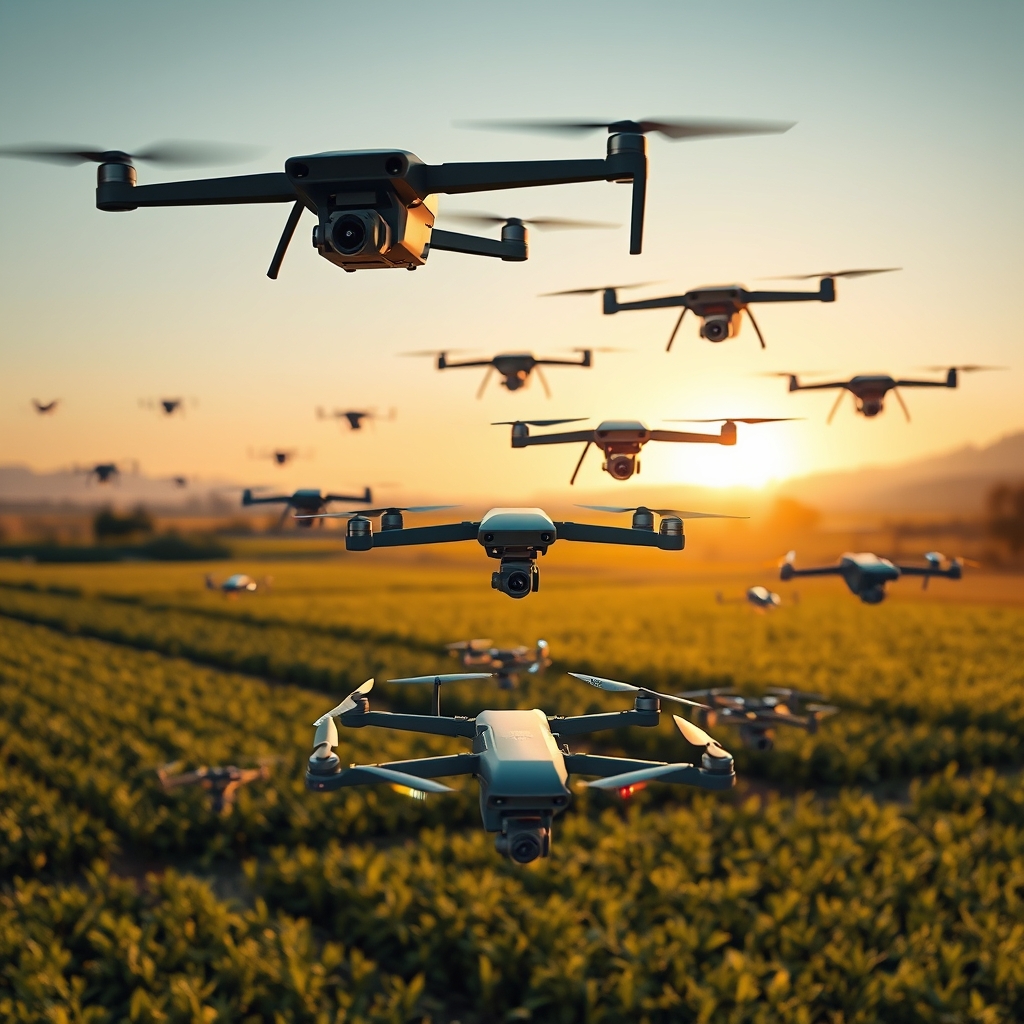
The hum of propellers cuts through the crisp morning air as a fleet of sleek, carbon fiber airframes ascends in perfect unison. These are not mere machines; they are the vanguard of a technological revolution, where the boundaries of flight are being redrawn by innovations that once existed only in the realm of science fiction. From the vast, golden expanses of agricultural fields to the intricate logistics networks that crisscross our cities, drones are no longer just tools—they are the architects of a new era, one where autonomy, precision, and intelligence converge to redefine what is possible in the skies above us.
The Alchemy of Autonomy: AI-Driven Navigation and Swarm Intelligence
At the heart of this transformation lies the alchemy of artificial intelligence, where algorithms and machine learning breathe life into autonomous flight systems. Imagine a swarm of drones, each no larger than a seagull, moving in perfect harmony like a murmuration of starlings. This is swarm intelligence in action, a symphony of coordinated movement where each unit communicates with its neighbors, adjusting its trajectory in real-time to avoid collisions, optimize paths, and achieve collective goals. The applications are as vast as they are revolutionary—from search and rescue missions in disaster-stricken areas to large-scale infrastructure inspections where human access is limited or perilous.
AI-driven navigation takes this a step further, enabling drones to make split-second decisions based on a myriad of inputs. Equipped with advanced sensors and edge computing UAV capabilities, these systems process data on the fly, literally. Obstacle avoidance technology, powered by LiDAR and high-resolution cameras, allows drones to navigate complex environments with the grace of a bird weaving through a dense forest. The result? A level of precision and reliability that was once the exclusive domain of human pilots, now scaled to an unprecedented degree.
Precision from Above: The Marriage of Drones and Agriculture
Nowhere is the impact of these advancements more tangible than in the fields of precision agriculture. Here, drones equipped with thermal imaging sensors and multispectral cameras become the eyes of farmers, scanning crops with a level of detail that was previously unimaginable. These aerial sentinels detect subtle variations in plant health, moisture levels, and nutrient deficiencies, painting a vivid picture of the land below. With this data, farmers can deploy resources with surgical precision, applying water, fertilizers, and pesticides only where needed, reducing waste and maximizing yields.
The integration of real-time kinematic positioning further enhances this precision, allowing drones to map fields with centimeter-level accuracy. Photogrammetry mapping transforms these data points into three-dimensional models, offering insights that guide everything from planting patterns to irrigation strategies. The result is a paradigm shift in agriculture, where technology and tradition converge to create a more sustainable, efficient, and productive future.
The Logistics Revolution: Delivery Drones and the Future of Mobility
Beyond the fields, the skies are buzzing with another kind of revolution—one that promises to redefine the way we think about delivery and logistics. Heavy-lift payload drones, capable of carrying everything from medical supplies to consumer goods, are already taking flight in pilot programs around the world. These machines, often designed as fixed-wing VTOL (Vertical Take-Off and Landing) hybrids, combine the efficiency of fixed-wing flight with the versatility of vertical take-off, making them ideal for both urban and remote environments.
Long-range telemetry and 5G connectivity ensure that these drones remain in constant communication with ground control, transmitting data and receiving updates in real-time. Remote identification systems, a critical component of modern drone regulations, allow authorities to monitor and manage air traffic, ensuring safety and compliance. Meanwhile, hydrogen-powered drones are pushing the boundaries of endurance, offering flight times that far exceed those of traditional battery-powered systems. This is not just the future of delivery—it is the future of mobility itself, where the skies become a new frontier for commerce and connectivity.
The Invisible Shield: Obstacle Avoidance and Kinetic Interception
As drones become more ubiquitous, so too does the need for systems that ensure their safe and secure operation. Obstacle avoidance technology, powered by a combination of sensors, AI, and edge computing, acts as an invisible shield, allowing drones to detect and evade potential hazards in their path. Whether it’s a sudden gust of wind, an unexpected structure, or another aircraft, these systems enable drones to react with lightning speed, ensuring safe passage through even the most challenging environments.
But what happens when a drone poses a threat? Enter kinetic drone interception, a cutting-edge technology designed to neutralize rogue or unauthorized UAVs. Using a combination of radar, AI, and precision-guided systems, these interceptors can identify, track, and safely disable drones that stray into restricted airspace. This technology is not just about security—it is about ensuring that the skies remain open and safe for all, a critical step as we move toward a future where drones are as common as cars on our roads.
The Materials of Tomorrow: Carbon Fiber and Brushless Motors
Beneath the sleek exteriors of modern drones lies a world of advanced materials and engineering marvels. Carbon fiber airframes, renowned for their strength and lightweight properties, form the backbone of these machines, enabling them to withstand the rigors of flight while maximizing efficiency. Paired with brushless motor efficiency, these drones achieve levels of performance that were once thought impossible, combining speed, agility, and endurance in a single package.
The synergy between these technologies is what allows drones to push the boundaries of what is possible. Whether it’s a long-endurance surveillance mission or a high-speed delivery, the combination of carbon fiber and brushless motors ensures that drones can meet the demands of even the most challenging tasks. This is the foundation upon which the future of flight is being built, a future where the skies are not just a pathway, but a platform for innovation.
The sun sets on the horizon, casting long shadows over the fields and cities below. Above, the first stars of the evening begin to twinkle, their light mingling with the soft glow of drone navigation lights. These machines, once the stuff of dreams, are now a tangible reality, weaving themselves into the fabric of our daily lives. They are not just tools, but partners in a journey toward a future where the skies are smarter, safer, and more connected than ever before. As we stand on the cusp of this new era, one thing is clear: the wings of tomorrow are already taking flight, carrying us toward a horizon filled with endless possibility.