The Luminous Harvest: How Thermal Imaging and Agentic AI Are Illuminating the Path to Precision Agriculture
In the quiet hours before dawn, when the world is still wrapped in the soft embrace of night, a revolution stirs in the fields. It is not the clatter of machinery or the hum of engines that heralds this change, but the silent, purposeful glow of thermal cameras sweeping across the landscape. These are not the fields of yesteryear, tended by calloused hands and weathered tools, but a new frontier where technology and tradition dance in harmony. Here, in the heart of precision agriculture, thermal imaging and agentic AI are rewriting the rules of cultivation, turning every leaf, every furrow, every whisper of the wind into data—data that holds the promise of abundance, sustainability, and a future where no resource is wasted.
The Eyes That See Beyond the Visible
Thermal imaging is not a new technology, but its application in agriculture has transformed it from a tool of surveillance and diagnostics into a beacon of insight. Unlike traditional cameras that capture only what the human eye can see, thermal cameras detect the invisible spectrum of heat radiating from every object. In the context of agriculture, this means they can reveal the hidden stories of crops: the stress of drought, the chill of frost, the fever of disease, or the silent struggle for nutrients. These are stories that unfold beneath the surface, where roots stretch and soil breathes, and where the naked eye is blind.
Imagine a vineyard at midnight, bathed in the eerie glow of thermal cameras mounted on drones. The vines, usually indistinguishable in the dark, now appear as a tapestry of colors, each hue a whisper of their condition. The warmer tones signal healthy, thriving plants, while cooler patches reveal areas where water is scarce or disease is taking hold. This is not just observation; it is revelation. And when this revelation is paired with the analytical prowess of agentic AI, the possibilities become limitless.
The Mind That Understands the Field
Agentic AI is not your typical artificial intelligence. It is not a passive observer, content to analyze data and spit out predictions. Instead, it is an active participant, a digital agronomist with the ability to make decisions, adapt strategies, and even predict outcomes before they unfold. In the realm of precision agriculture, agentic AI acts as the brain to thermal imaging’s eyes, interpreting the heat maps and translating them into actionable insights. It can determine when a field needs water, where pests are likely to strike, or how a crop’s growth trajectory will unfold over the season. But more than that, it can act on these insights autonomously, adjusting irrigation systems, deploying drones for targeted pesticide application, or even rerouting farm machinery to avoid compacting stressed soil.
The true power of agentic AI lies in its ability to learn and evolve. Every season, every harvest, every unexpected storm or heatwave becomes a lesson, refining its algorithms and sharpening its predictions. It is a cycle of continuous improvement, where the AI grows smarter with each passing day, much like a farmer who has spent a lifetime tending the same land. But unlike the farmer, the AI never tires, never forgets, and never overlooks a single detail. It is the perfect partner, a silent guardian of the fields that never sleeps.
The Dance of Data and Decision
The marriage of thermal imaging and agentic AI is not just about collecting data; it is about turning that data into decisions. Consider the challenge of irrigation, one of the most critical and resource-intensive aspects of farming. Traditional methods rely on broad estimates, often leading to overwatering in some areas and underwatering in others. But with thermal imaging, every plant’s water needs can be assessed individually. The AI analyzes the thermal data, identifies patterns of stress, and adjusts the irrigation system in real-time, delivering water only where and when it is needed. The result is not just a reduction in water usage, but a crop that is healthier, more resilient, and more productive.
This precision extends beyond water. Thermal imaging can detect the early signs of pest infestations, allowing the AI to deploy targeted interventions before the problem spreads. It can identify nutrient deficiencies by analyzing the subtle temperature variations in leaves, enabling the AI to recommend precise fertilizer applications. It can even predict yield outcomes by tracking the thermal signatures of crops throughout the growing season, giving farmers the foresight to plan for storage, transportation, and market demands. In every case, the goal is the same: to replace guesswork with certainty, waste with efficiency, and uncertainty with control.
The Human Touch in a Digital Age
For all its sophistication, the technology of thermal imaging and agentic AI does not seek to replace the farmer. Instead, it seeks to empower them, to elevate their role from laborer to strategist. The farmer of the future is not the one who toils under the sun, but the one who interprets the data, refines the algorithms, and makes the final call on when to plant, when to harvest, and when to let the land rest. This is a partnership, one where human intuition and machine intelligence combine to create something greater than the sum of their parts.
There is a beauty in this collaboration, a harmony between the ancient art of farming and the cutting-edge science of AI. It is a reminder that progress is not about discarding the old for the new, but about finding ways to blend the two. The fields of tomorrow will still be tended by human hands, but those hands will be guided by eyes that see beyond the visible and minds that understand the language of the land. In this luminous harvest, every decision is informed, every action is precise, and every resource is cherished. The future of agriculture is not just about feeding the world; it is about doing so with wisdom, with care, and with a deep respect for the earth that sustains us all.
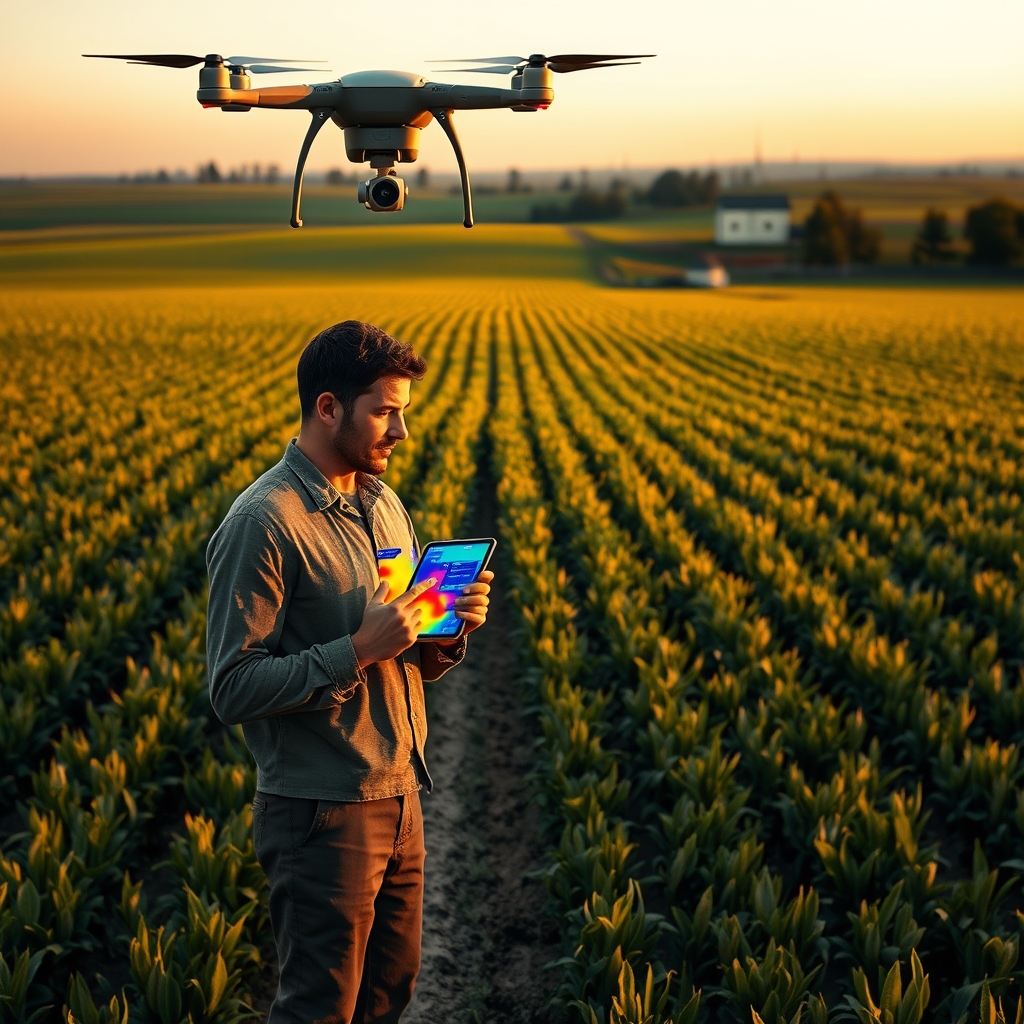
As the first light of dawn breaks over the horizon, the thermal cameras dim, their work for the night complete. But the AI remains vigilant, processing the data, refining its models, and preparing for the day ahead. The fields, now bathed in golden sunlight, stand ready for another cycle of growth, another season of promise. And somewhere in the distance, a farmer checks the latest insights on a tablet, a smile playing on their lips as they step into a day shaped not by uncertainty, but by the quiet confidence of knowing exactly what the land needs. This is the luminous harvest, where technology and tradition converge to illuminate a path forward, one where the fields of tomorrow are as bountiful as they are sustainable.