The Invisible Harvest: How Agentic AI and Multispectral Imaging Are Cultivating Precision Agriculture’s Next Frontier
Beneath the vast, open skies of modern farmland, a quiet revolution is taking root—one that is as subtle as it is transformative. The fields, once ruled by the rhythm of seasons and the intuition of farmers, are now humming with the silent intelligence of machines. At the heart of this shift lies a powerful convergence: Agentic AI and multispectral imaging, two technologies that are not just changing how we grow food but redefining the very essence of agriculture itself. Together, they are turning the soil into a living data canvas, where every leaf, every root, and every drop of water tells a story waiting to be deciphered.
The Eyes That See Beyond the Visible
Imagine standing in the middle of a cornfield, the golden stalks swaying gently in the breeze. To the naked eye, the plants appear uniform, healthy, and thriving. But beneath this serene surface, a hidden world of stress, nutrient deficiencies, and early-stage diseases lurks—one that only reveals itself when it’s often too late to act. This is where multispectral imaging steps in, like a pair of supernatural glasses that peel back the layers of reality. By capturing light across multiple wavelengths—beyond what human eyes can perceive—these advanced sensors detect the invisible signatures of plant health.
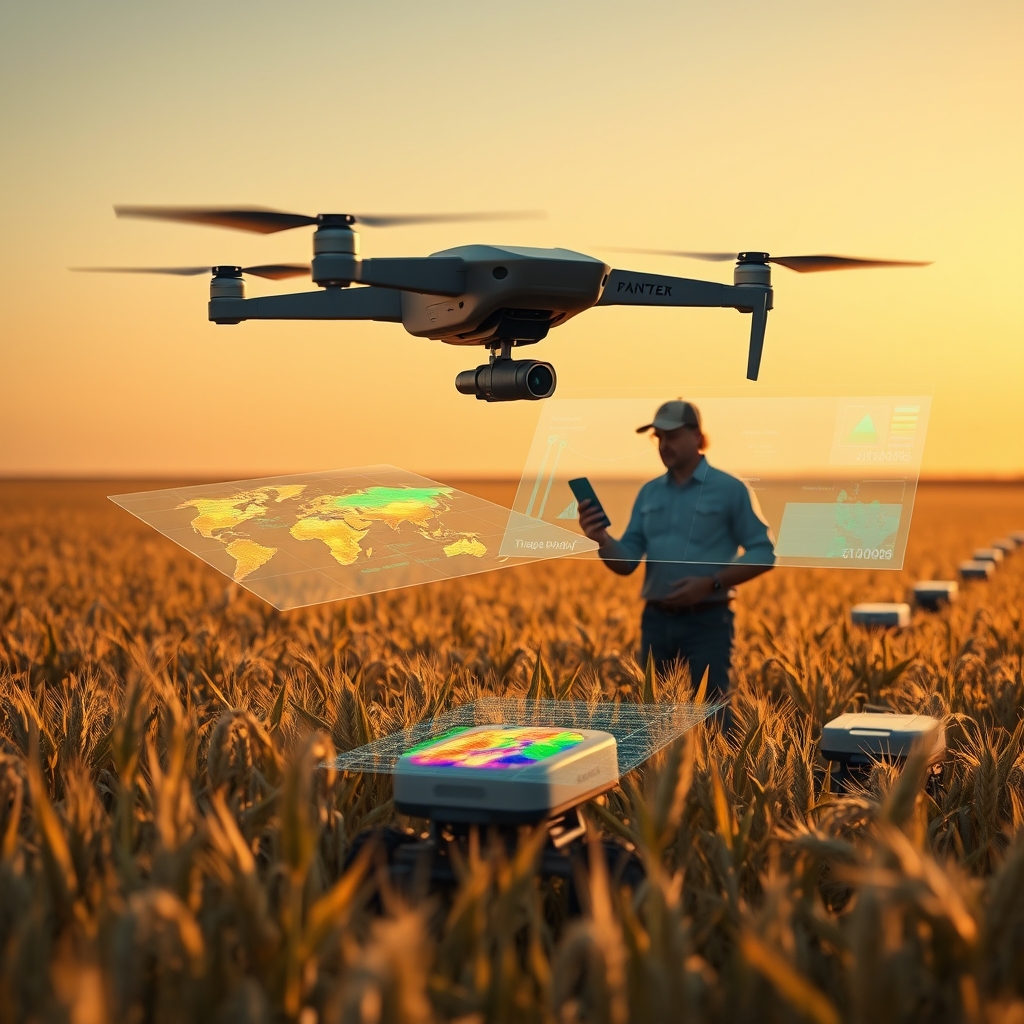
Drones equipped with multispectral cameras soar above the fields, their lenses scanning the crops in bands of red, green, near-infrared, and beyond. Each wavelength tells a different story: near-infrared light reveals the vigor of vegetation, while red-edge bands expose early signs of stress. The data is not just a snapshot; it’s a dynamic, living map of the farm, updated in real-time as conditions change. Farmers, once reliant on guesswork and experience, now hold in their hands a precision tool that can predict yield, detect pests, and even assess soil moisture levels—all before a single plant shows visible signs of distress.
The Brain Behind the Brawn: Agentic AI
But data alone is not enough. The true magic happens when this flood of information is met with the cognitive power of Agentic AI—a form of artificial intelligence that doesn’t just analyze data but acts upon it with autonomy and intent. Unlike traditional AI, which waits for human input, Agentic AI systems are designed to make decisions, adapt to new scenarios, and even collaborate with other machines to achieve a common goal. In the context of precision agriculture, this means an AI that doesn’t just tell farmers what’s wrong with their crops but takes the next step: prescribing solutions, optimizing resource allocation, and even deploying autonomous machinery to address issues in real-time.
Picture this: A drone equipped with multispectral sensors detects a patch of wheat suffering from nitrogen deficiency. Instead of merely flagging the issue for a farmer to address later, the Agentic AI system springs into action. It calculates the precise amount of fertilizer needed, dispatches a ground-based robot to apply it, and adjusts the irrigation schedule to ensure optimal absorption. Meanwhile, the AI continuously monitors the field, learning from each intervention and refining its approach. It’s a closed-loop system where technology doesn’t just observe—it participates, adapts, and evolves.
The Ripple Effect: Sustainability and Beyond
The implications of this technological marriage extend far beyond increased yields or reduced labor costs. At its core, the fusion of Agentic AI and multispectral imaging is a story about sustainability. Agriculture is one of the largest consumers of water and a significant contributor to greenhouse gas emissions. Traditional farming methods often rely on blanket applications of water, fertilizers, and pesticides, leading to waste, runoff, and environmental degradation. Precision agriculture flips this model on its head, replacing guesswork with pinpoint accuracy.
By targeting only the areas that need attention, farmers can drastically reduce their use of resources. Water is delivered precisely where and when it’s needed, minimizing waste. Fertilizers and pesticides are applied in micro-doses, reducing runoff into nearby waterways. Even energy consumption is optimized, as autonomous machinery operates with efficiency that human labor simply cannot match. The result is a farming ecosystem that is not only more productive but also kinder to the planet—a rare win-win in an industry often caught between the demands of profit and environmental stewardship.
The Human Element: A New Partnership
Yet, for all its technological prowess, this revolution is not about replacing farmers. It’s about empowering them. The best tools are those that amplify human potential, and Agentic AI and multispectral imaging are no exception. Farmers are no longer just stewards of the land; they are data scientists, strategists, and innovators. The technology handles the heavy lifting of data collection and analysis, freeing farmers to focus on what they do best: making informed, strategic decisions that shape the future of their land.
This partnership between human and machine is already yielding remarkable results. In regions where water scarcity is a growing concern, precision agriculture has enabled farmers to maintain yields with a fraction of the water previously required. In areas plagued by pests, early detection through multispectral imaging has allowed for targeted interventions, reducing the need for broad-spectrum pesticides. And in the face of climate change, which is making weather patterns increasingly unpredictable, these technologies provide a level of resilience that was once unimaginable.
The Fields of Tomorrow
As we stand on the brink of this new era, it’s worth pausing to consider what the future holds. The fields of tomorrow will not be silent, passive landscapes but vibrant, dynamic ecosystems where technology and nature coexist in harmony. Drones will become as common as tractors, their hum a familiar soundtrack to the daily rhythm of farm life. Agentic AI systems will evolve from tools into trusted partners, their algorithms growing more sophisticated with each passing season. And the data they generate will not just inform decisions but shape entire agricultural policies, driving global efforts toward sustainability and food security.
Yet, for all the promise, challenges remain. The adoption of these technologies requires investment, training, and a willingness to embrace change—hurdles that are not insignificant, especially for small-scale farmers. There are also ethical considerations, such as data privacy and the potential for over-reliance on technology. But these challenges are not insurmountable. With the right support, education, and infrastructure, the benefits of precision agriculture can be democratized, ensuring that no farmer is left behind in this new frontier.
The fields we tend today are not just plots of land; they are the foundation of our future. In the dance of light and data, of algorithms and soil, we are witnessing the birth of a new kind of agriculture—one that is smarter, more sustainable, and infinitely more precise. It’s a future where the invisible becomes visible, where every decision is informed, and where the harvest is not just abundant but also in harmony with the earth. The seeds of this revolution have already been planted; now, it’s time to watch them grow.