
The Sky’s No Limit: How Advanced Drone Technology is Reshaping Industries
The hum of propellers and the silent glide of wings are no longer just the sounds of hobbyist enthusiasts. Drones, once a niche technology, have rapidly evolved into sophisticated tools poised to revolutionize nearly every industry. From the meticulous fields of agriculture to the complex logistics of package delivery, the advancements in autonomous flight systems, sensor technology, and AI-driven navigation are creating possibilities that were unimaginable just a decade ago. This technological surge is not just about flying machines; it’s about intelligent systems capable of performing complex tasks with unprecedented efficiency and precision.
Precision Agriculture: Sowing the Seeds of a Smarter Future
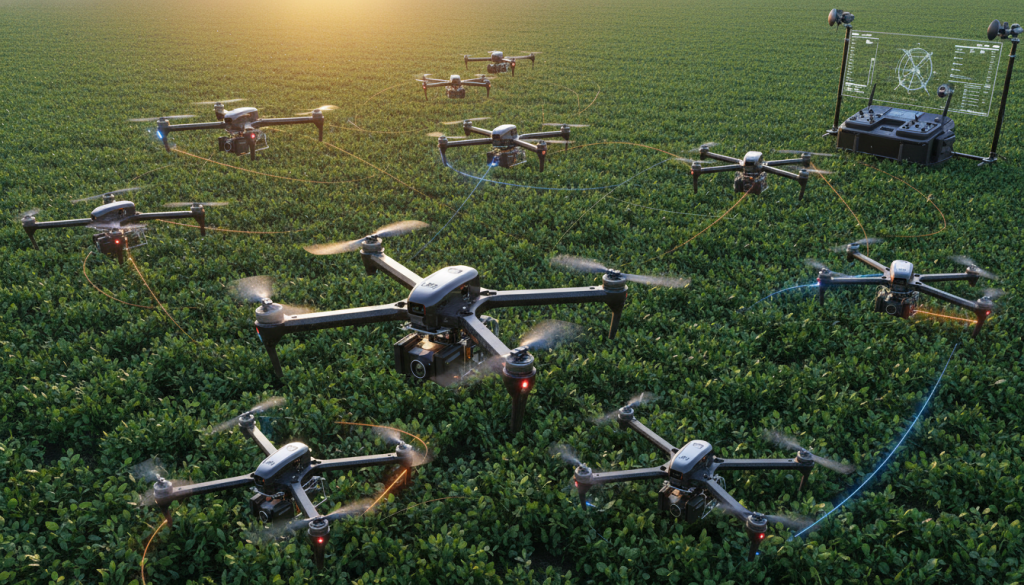
Precision agriculture is a prime example of this transformation. Precision Agriculture Drones equipped with a suite of advanced sensors are becoming indispensable for modern farming. Thermal imaging sensors can detect subtle changes in plant health, revealing issues like irrigation problems or pest infestations long before they are visible to the human eye. Photogrammetry mapping allows farmers to create highly detailed 3D models of their fields, enabling precise application of fertilizers, pesticides, and water, thereby reducing waste and increasing crop yields. Coupled with Real Time Kinematic (RTK) positioning, these drones can navigate fields with centimeter-level accuracy, ensuring every square meter is monitored and treated optimally. This data-driven approach not only boosts productivity but also promotes environmental sustainability by minimizing chemical runoff and optimizing resource usage.
Logistics and Delivery: The Dawn of Autonomous E-commerce
The dream of receiving packages delivered by drone is rapidly becoming a reality, thanks to breakthroughs in delivery drone logistics. Companies are investing heavily in developing robust systems capable of handling the complexities of urban and rural delivery. Autonomous flight systems are being refined to navigate busy airspace, while advanced obstacle avoidance technology ensures safe operation around buildings, power lines, and other aerial traffic. Long range telemetry is crucial for maintaining communication and control over extended delivery routes, and the development of 5G connectivity promises to enhance this capability further, enabling real-time data exchange and swarm coordination. Heavy lift payload drones are also emerging, capable of transporting larger and heavier items, expanding the scope of what drone delivery can achieve.
Beyond Delivery: Surveillance, Inspection, and Public Safety
The applications extend far beyond commercial delivery. Drones are proving invaluable in infrastructure inspection, industrial monitoring, and public safety. Imagine inspecting wind turbines or bridges using drones equipped with high-resolution cameras and thermal imaging sensors. This not only reduces risk to human inspectors but also provides more comprehensive data for maintenance planning. In disaster response, drones can quickly survey damaged areas, locate survivors, and deliver critical supplies. The integration of AI-driven navigation allows drones to autonomously plan routes, identify points of interest, and even perform complex maneuvers in challenging environments. For areas with limited or no infrastructure, hydrogen powered drones offer a compelling solution for extended flight times and reduced environmental impact.
The Power of Collaboration and Intelligence
The concept of swarm intelligence is also gaining traction, enabling multiple drones to work together collaboratively. This can be applied to large-scale mapping projects, search and rescue operations, or even agricultural spraying, where a coordinated fleet can cover vast areas much faster than a single drone. Edge computing UAV platforms are also becoming more prevalent, allowing drones to process data onboard in real-time, reducing reliance on constant ground communication and enabling faster decision-making. This is particularly important for applications requiring immediate action, such as kinetic drone interception for security purposes or dynamic route adjustments in complex delivery networks. The use of lightweight yet durable materials like carbon fiber airframes and highly efficient brushless motor efficiency are also key enablers, contributing to longer flight times, increased payload capacity, and overall operational effectiveness.
The Evolving Landscape of Aerial Operations
The regulatory landscape is also evolving to accommodate these advancements. Technologies like Remote Identification are being developed and implemented to ensure accountability and safety in increasingly crowded skies. For those who prefer an immersive experience, First Person View (FPV) drones offer an exciting way to pilot aircraft, opening up new possibilities for cinematography, racing, and even complex industrial tasks requiring a pilot’s direct perspective. The development of fixed wing VTOL (Vertical Take-Off and Landing) drones combines the benefits of multirotor maneuverability with the efficiency and speed of fixed-wing flight, enabling longer-range missions and faster transit times. As these technologies mature and integrate, the potential for drones to enhance human capabilities and transform industries becomes increasingly apparent, pushing the boundaries of what is possible in aerial operations.