The New Frontier: Powering, Protecting, and Propelling Humanity Deeper into Space
Humanity stands at the precipice of a new golden age of space exploration and utilization. What was once the exclusive domain of national space agencies is rapidly becoming a vibrant ecosystem, driven by an unprecedented convergence of advanced technologies. From the reusable rockets that make access routine to the sophisticated systems that will power and protect our endeavors, a symphony of innovation is reshaping our destiny beyond Earth.
The New Era of Access: Reusable Launch Vehicles
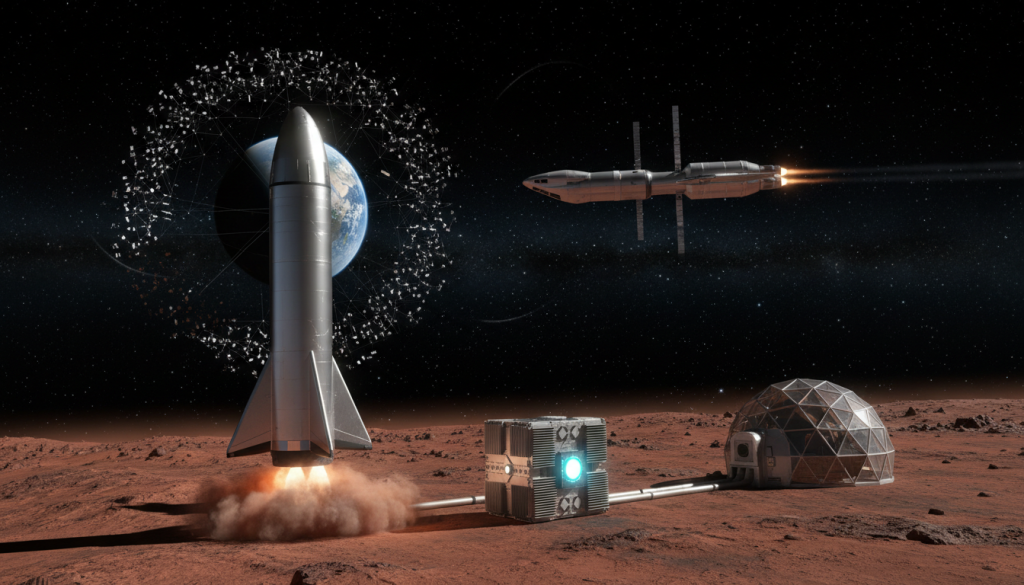
The revolution in space access began with the advent of Reusable Launch Vehicles (RLVs). Gone are the days when multi-million dollar rockets were discarded after a single use. Companies pioneering vertical landing and re-flight technologies have drastically reduced the cost and increase the frequency of launches. This paradigm shift has not only democratized access to Low Earth Orbit (LEO) but has also made ambitious deep space missions more economically viable. The ability to launch heavier payloads more often means more experiments, more satellites, and ultimately, more opportunities for humanity to expand its presence in the cosmos.
Powering Beyond Earth: Small Modular Reactors and Advanced Nuclear Propulsion
As we venture further from Earth, the challenges of power generation and efficient propulsion become paramount. Chemical rockets, while powerful, are limited by their fuel efficiency and the sheer mass of propellant required for long-duration, high-velocity missions. Similarly, solar power diminishes rapidly the further one travels from the sun, and is non-existent during lunar nights or on shadowed planetary surfaces.
Terrestrial and Lunar Power with SMRs
This is where Small Modular Reactors (SMRs) enter the cosmic stage. These compact, robust nuclear fission reactors offer a game-changing solution for sustained power generation in harsh environments. On the Moon or Mars, SMRs could provide reliable, high-density energy for habitats, scientific instruments, and resource extraction operations, ensuring uninterrupted power regardless of sunlight availability. Their modular design allows for easier transport and deployment, making them ideal for establishing permanent off-world bases.
The Promise of Advanced Nuclear Propulsion
Beyond static power, nuclear energy holds the key to faster transit times across the solar system. Advanced Nuclear Propulsion technologies, such as nuclear thermal propulsion (NTP) or nuclear electric propulsion (NEP), promise significantly higher thrust-to-weight ratios and specific impulses compared to traditional chemical rockets. NTP, for instance, could reduce travel times to Mars from months to mere weeks, drastically cutting down astronaut exposure to radiation and making round trips more feasible. This leap in propulsion efficiency is not just about speed; it’s about enabling larger payloads, more complex missions, and ultimately, making true Deep Space Exploration a practical reality rather than a distant dream.
Sustaining the Orbital Frontier: Space Situational Awareness and Debris Mitigation
While the proliferation of satellites for Low Earth Orbit Telecommunications and other services is a testament to our ingenuity, it also introduces significant challenges. The orbital environment is becoming increasingly crowded, raising concerns about collisions and the generation of dangerous debris.
The Imperative of Space Situational Awareness
Space Situational Awareness (SSA) is the critical discipline of tracking objects in orbit, predicting their trajectories, and preventing potential collisions. With thousands of new satellites being launched, and hundreds of thousands of pieces of orbital debris, robust SSA systems are more vital than ever. Advanced sensor networks, AI-driven analytics, and international data sharing are crucial for maintaining a clear picture of the orbital environment, safeguarding active satellites, and planning safe launch and re-entry corridors.
Tackling Orbital Debris
The threat posed by Orbital Debris Mitigation is not merely theoretical; it’s a growing hazard that could render certain orbits unusable. Strategies range from designing satellites for controlled deorbit at the end of their operational lives to developing active debris removal technologies. Precision Strike Technology, initially developed for other purposes, is now being explored for its potential in safely de-orbiting defunct satellites or large pieces of debris, without creating further fragmentation. International cooperation and adherence to best practices are essential to ensure the long-term sustainability of space activities for all.
Charting the Course for Deep Space Exploration
The synthesis of these advanced capabilities paints a vivid picture of humanity’s future in space. Reusable Launch Vehicles provide the frequent, cost-effective access. Small Modular Reactors offer the sustained power for lunar outposts and planetary bases. Advanced Nuclear Propulsion shatters the time barriers to distant worlds, making ambitious missions like asteroid mining logistics or manned missions to the outer solar system truly achievable. Meanwhile, Space Situational Awareness and Orbital Debris Mitigation ensure that our expansion is responsible and sustainable, preserving the orbital highways for generations to come.
This integrated approach is not just about reaching further; it’s about building a lasting presence, fostering scientific discovery, and unlocking new resources that can benefit all of humanity. The pathways to the Moon, Mars, and beyond are being paved not with a single breakthrough, but with the careful and deliberate convergence of multiple, groundbreaking technologies, each playing a vital role in our collective journey into the deep unknown. Our ability to responsibly manage this growth, ensuring safety and sustainability, will define not just the next few decades, but the very trajectory of human civilization among the stars.