
The Algorithmic Vanguard: How Agentic Intelligence is Redefining Air Superiority
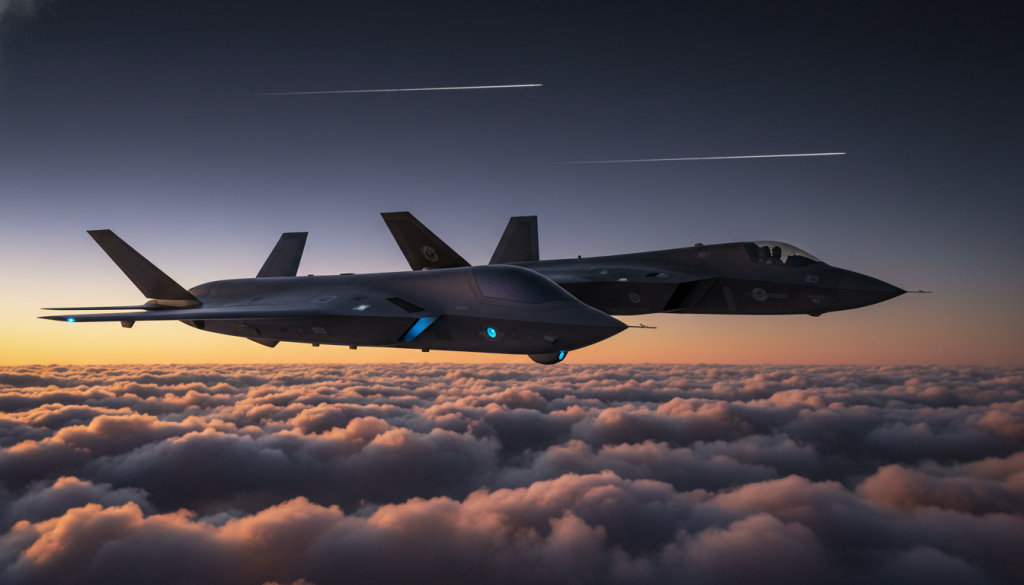
The architecture of air superiority is undergoing a radical, irreversible fracture. For decades, the tactical advantage in the skies relied on the exquisite engineering of manned platforms—multimillion-dollar fighter jets flown by highly trained human operators. Today, that calculus is rapidly becoming obsolete. The proliferation of advanced anti-access/area-denial (A2/AD) networks has rendered traditional force structures dangerously fragile. In response, a new doctrine is emerging, anchored not in the cockpit, but in the silicon. The integration of Agentic Intelligence into autonomous aircraft is dismantling the legacy reliance on human pilots, substituting human cognitive limits with algorithmic precision and decentralized lethality. The development of these next-generation fleets relies heavily on Digital Twins, allowing engineers to simulate millions of combat scenarios and stress-test predictive maintenance models before a physical prototype ever leaves the hangar.
The Operational Shift to Loyal Wingmen
The concept of the unmanned aerial vehicle (UAV) is not novel; remotely piloted drones have defined asymmetric warfare for over two decades. However, the transition toward “Loyal Wingmen”—collaborative combat aircraft designed to fly alongside manned fighters—represents a fundamental leap in operational capability. These are not merely remote-controlled bomb trucks. They are force multipliers engineered to absorb risk, penetrate highly contested airspace, and deliver kinetic or electronic payloads with ruthless efficiency. The critical distinction lies in their autonomy. Legacy drones require constant satellite communication links, making them highly susceptible to electronic warfare and signal degradation. Loyal Wingmen, conversely, are designed to operate in electromagnetically denied environments. By distributing sensors, weapons, and electronic warfare pods across a swarm of autonomous aircraft, military planners can achieve localized air dominance without risking irreplaceable human capital or exquisite, high-value platforms.
Agentic Intelligence: Beyond Simple Automation
Autonomy in aviation has historically meant adherence to pre-programmed waypoints or deterministic rulesets. Agentic Intelligence shatters this paradigm. Unlike narrow artificial intelligence that reacts to specific triggers, Agentic Intelligence possesses the capacity for goal-oriented behavior, dynamic reasoning, and independent decision-making within fluid, unpredictable environments. When a loyal wingman equipped with Agentic Intelligence encounters an unexpected surface-to-air missile threat, it does not simply alert a human operator and wait for instructions. It autonomously calculates the threat envelope, coordinates with other autonomous assets in the formation, initiates electronic countermeasures, and dynamically reroutes its flight path—all in milliseconds. This level of agency shifts the human role from “operator” to “commander.” The human pilot in the loop no longer manages the aircraft’s stick and rudder or individual sensor pods; instead, they manage the broader tactical intent, allowing the agentic systems to determine the optimal method of execution.
Executing Multi Domain Coordination
The true lethality of autonomous aircraft is realized only through seamless Multi Domain Coordination. A loyal wingman does not operate in a vacuum. It acts as a node within a vast, interconnected kill web that spans air, land, sea, space, and cyberspace. Agentic Intelligence allows these platforms to ingest and synthesize massive volumes of data from low earth orbit constellations, quantum sensors, and ground-based radar arrays in real-time. If a satellite communication link is severed by an adversary’s counter-space operation, the autonomous aircraft must seamlessly transition to alternative, localized mesh networks to maintain situational awareness. This multi-domain synthesis enables predictive targeting and rapid exploitation of fleeting tactical windows. The aircraft becomes both a sensor and a shooter, capable of identifying an electronic warfare emitter, cross-referencing its signature with space-based intelligence, and executing a precision strike before the adversary can relocate.
The Economics of Algorithmic Attrition
Beyond tactical advantages, the pivot toward autonomous loyal wingmen is driven by a stark economic reality. Modern fifth- and sixth-generation fighters are unsustainably expensive, both to procure and to maintain. The loss of a single exquisite platform in a peer-level conflict represents a catastrophic degradation of combat capability. Autonomous aircraft introduce the concept of “affordable mass.” By stripping away the life support systems, displays, and structural reinforcements required for a human pilot, manufacturers can produce highly capable combat aircraft at a fraction of the cost. These systems are designed with a degree of expendability. While not cheap in absolute terms, they are attritable. If a loyal wingman is lost while drawing fire away from a manned stealth fighter or destroying a critical air defense node, the exchange ratio is heavily skewed in favor of the attacker. The realization of this affordable mass heavily depends on securing the supply chain through initiatives like the Microelectronics Commons, ensuring that the advanced semiconductors powering these agentic systems are robust, secure, and domestically produced.
The transition from human-centric cockpits to agentic, autonomous architectures is not merely a technological upgrade; it is a fundamental reorganization of combat philosophy. As algorithms become the primary arbiters of tactical execution, the advantage will inevitably shift to the force that can rapidly field, update, and trust its artificial intelligence under fire. The sky will no longer be contested by individual aces dogfighting in the stratosphere, but by decentralized networks of silicon and steel, silently calculating the geometry of survival at the speed of light. The future of air superiority belongs to the machines that can think, adapt, and act entirely on their own, forever altering the calculus of global power projection.