
The Silent Revolution: How Agentic Intelligence and Loyal Wingmen are Rewriting Aerospace Dominance
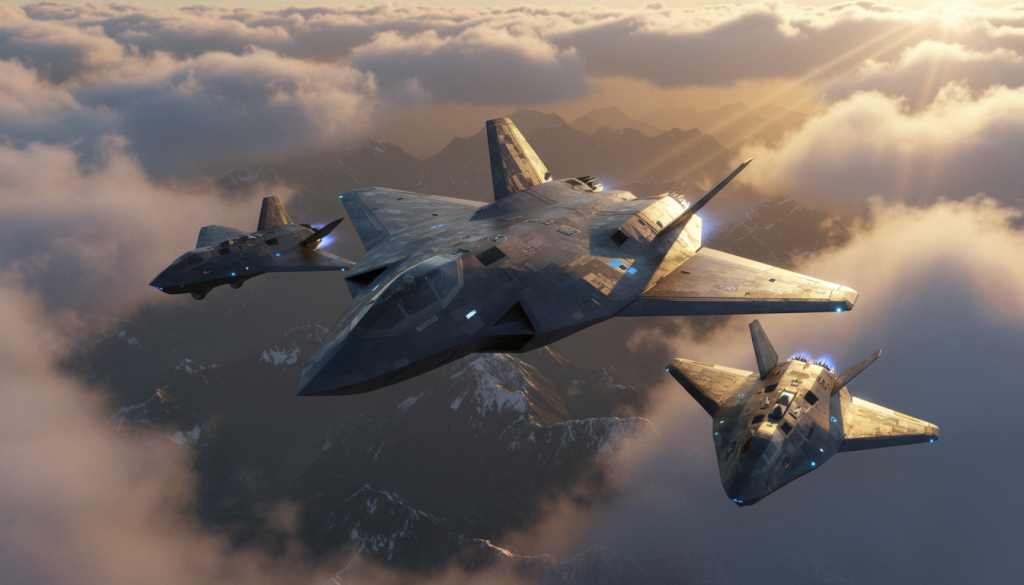
The skies above tomorrow’s battlefields will not be defined solely by the roar of traditional jet engines or the solitary heroics of human pilots. Instead, a silent, cognitive revolution is taking flight. As global defense paradigms shift, the reliance on human-centric operations is rapidly giving way to a highly interconnected, intelligent, and autonomous operational theater. This transformation represents the most significant leap in aerospace capabilities since the invention of the jet engine, fundamentally altering how air superiority is achieved and maintained.
At the heart of this paradigm shift is the integration of advanced computational models with cutting-edge aerospace engineering. We are moving beyond remote-controlled drones into an era where machines possess the cognitive architecture to analyze, adapt, and act within milliseconds. This evolution is not merely about removing the pilot from the cockpit; it is about expanding the tactical envelope, pushing the boundaries of G-forces, endurance, and strategic complexity far beyond human physical limitations.
The Dawn of Autonomous Aircraft
Autonomous aircraft are no longer relegated to the realm of science fiction or theoretical research and development. Today, they form the backbone of next-generation air dominance strategies. Unlike their predecessors, which relied heavily on continuous human input and pre-programmed waypoints, modern autonomous platforms are designed to thrive in highly contested, dynamic environments. They can independently navigate through GPS-denied zones, evade sophisticated anti-aircraft systems, and identify targets with unprecedented precision.
The true value of these autonomous systems lies in their scalability and expendability. By deploying swarms of uncrewed aerial vehicles (UAVs), defense forces can overwhelm adversary radar networks and deplete defensive munitions. This mass-centric approach forces opponents into impossible tactical dilemmas, ensuring that high-value human-crewed assets remain safely outside the most lethal threat rings while the autonomous vanguard executes the high-risk phases of the mission.
Redefining Teamwork: The Loyal Wingmen Concept
Within this autonomous ecosystem, the concept of Loyal Wingmen has emerged as a critical bridge between human ingenuity and machine efficiency. A Loyal Wingman is an advanced, uncrewed combat aircraft designed to fly alongside crewed fighter jets, acting as a force multiplier. Commanded by the human pilot in the lead aircraft, these robotic wingmen can carry extra munitions, act as forward sensors, or even sacrifice themselves to intercept incoming missiles.
This human-machine teaming ensures that the tactical intuition and moral decision-making of a human pilot remain central to the mission, while the Loyal Wingmen handle the cognitive overload of data processing and immediate threat response. The human pilot transitions from a traditional dogfighter to a battlefield manager, orchestrating a localized fleet of robotic combatants to execute complex, multi-layered strategies that would be impossible for a single aircraft to achieve.
The Cognitive Engine: Agentic Intelligence
What makes a Loyal Wingman truly effective is the underlying software architecture, specifically the deployment of agentic intelligence. Traditional artificial intelligence often relies on pattern recognition and rigid rule sets. Agentic intelligence, however, endows the aircraft with goal-oriented behavior. The system is given a broader objective—such as protecting the lead aircraft or suppressing enemy air defenses in a specific sector—and it autonomously determines the optimal sequence of actions to achieve that goal.
This level of autonomy allows the aircraft to react to unforeseen variables in real-time. If an enemy deploys unexpected electronic warfare countermeasures, an agentic system does not simply crash or return to base; it analyzes the interference, reroutes its communication nodes, and alters its flight path to outmaneuver the threat. This resilient, adaptive behavior is what transforms a simple drone into a genuine tactical partner.
Perfecting the Machine with Digital Twins
Sustaining this level of technological sophistication requires equally advanced maintenance and development protocols. Enter the concept of digital twins. Every autonomous aircraft and Loyal Wingman deployed in the physical world has a high-fidelity, virtual counterpart. This digital twin is constantly updated with real-time telemetry, structural stress data, and software performance metrics gathered from the physical aircraft.
By running simulations on the digital twin, engineers can foresee mechanical failures before they occur, optimizing predictive maintenance schedules and drastically reducing downtime. Furthermore, new software updates, tactical algorithms, and agentic intelligence models can be rigorously tested on the digital twin in a virtual combat environment before being pushed to the physical fleet, ensuring absolute reliability when lives are on the line.
Orchestrating the Battlefield: Multi Domain Coordination
The true potential of autonomous aircraft, Loyal Wingmen, and their agentic intelligence is only fully realized through seamless multi domain coordination. The modern battlefield is not segmented into isolated theaters of air, land, sea, space, and cyber. It is a singular, interconnected web. An autonomous jet flying a sortie must be able to instantly share targeting data with naval destroyers, receive real-time satellite imagery from low earth orbit constellations, and coordinate with ground-based electronic warfare units.
Multi domain coordination ensures that the vast amounts of data collected by the sensors of autonomous aircraft are instantly synthesized and distributed across the entire joint force. This creates a ubiquitous operational picture, allowing commanders to strike with overwhelming speed and precision from multiple vectors simultaneously, neutralizing threats before the adversary even realizes they have been detected.
As we look toward the horizon, the fusion of human strategy and machine execution is fundamentally rewriting the doctrines of global security. The skies will increasingly belong to networks of highly intelligent, adaptive systems that learn from every encounter and evolve with every mission. The integration of advanced computational cognition into aerodynamic frames is not just an upgrade in hardware; it is a profound reimagining of aerospace potential.
Ultimately, the success of these next-generation fleets will hinge on our ability to trust and refine the invisible algorithms that guide them. As the line between pilot and programmer blurs, the nations that master the delicate balance of human oversight and autonomous freedom will define the future of aerospace dominance. The silent revolution in the clouds is already underway, and it promises a future where the speed of thought is the ultimate weapon.