
The Dawn of a New Space Age: Reusable Rockets and the Future of Orbit
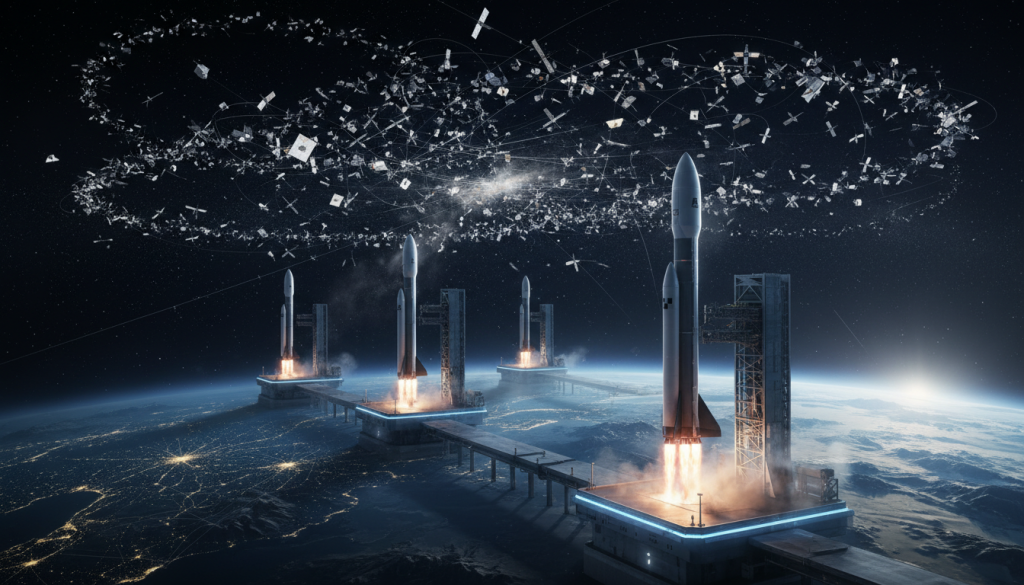
The cosmos, once an exclusive domain for national governments and highly funded scientific endeavors, is rapidly transforming into a bustling arena of innovation and commerce. This seismic shift is largely powered by a paradigm-altering technology: reusable launch vehicles. No longer confined to the costly, single-use rockets of yesteryear, humanity is now poised to access space with unprecedented frequency and affordability, opening doors to possibilities once relegated to science fiction novels. This accessibility is not merely about launching more satellites; it’s about fundamentally rethinking our relationship with the final frontier and harnessing its potential for global benefit.
The Reusable Revolution
The advent of fully or partially reusable launch vehicles has been nothing short of a game-changer. Companies like SpaceX, Blue Origin, and Rocket Lab have spearheaded this revolution, demonstrating that the ability to land and refly rocket boosters dramatically slashes the per-launch cost. Historically, a significant portion of a rocket’s cost was tied to its construction, a cost that was written off after a single mission. Reusability turns this model on its head, making space access akin to air travel, where the same aircraft performs multiple flights. This economic efficiency is not just an incremental improvement; it’s an exponential one, making ambitious projects financially viable that were previously unimaginable.
Driving Down Costs and Accelerating Access
Lower launch costs have a cascading effect across the entire space industry. Startups can now afford to develop and deploy their own technologies, fostering a vibrant ecosystem of innovation. Scientific missions, previously constrained by tight budgets and infrequent launch windows, can now be planned with greater flexibility and frequency. This acceleration of access is critical for rapid technological iteration and deployment, ensuring that advancements in space hardware and software can be brought to orbit faster than ever before. The ultimate goal is to make space access so routine and economical that it becomes a commonplace utility, much like global shipping or air freight.
Beyond Earth: The Vision for Lunar and Martian Missions
While the immediate impact of reusable launch vehicles is most evident in Earth orbit, their true potential extends far beyond. The vision for sustainable lunar bases, asteroid mining logistics, and eventual human missions to Mars hinges critically on the ability to transport massive amounts of cargo and personnel repeatedly and affordably. Imagine a future where components for interplanetary spacecraft are assembled in Earth orbit, fueled by resources brought up by a fleet of reusable heavy-lift rockets. This isn’t just about reaching other celestial bodies; it’s about establishing a permanent, self-sustaining human presence off-world, leveraging the economies of scale that reusability provides.
The Proliferation of LEO Telecommunications
Hand-in-hand with the reusable rocket revolution is the explosion of Low Earth Orbit (LEO) telecommunications constellations. Projects like Starlink, OneWeb, and Amazon’s Project Kuiper aim to blanket the globe with high-speed internet, connecting remote areas and providing robust, low-latency connectivity. These constellations consist of thousands of small, interconnected satellites, forming a vast network that promises to bridge the digital divide and revolutionize global communication. The affordability offered by reusable launchers is a primary enabler for deploying such massive numbers of spacecraft, making these ambitious projects feasible.
Connecting the Unconnected
The social and economic implications of ubiquitous LEO telecommunications are profound. For billions of people in underserved regions, access to reliable internet means access to education, healthcare, economic opportunities, and global information. It can spur local economies, empower communities, and foster greater global collaboration. From precision agriculture in remote farmlands to emergency response in disaster zones, the applications are endless, promising a more interconnected and equitable world.
The Challenge of Congestion and Debris
However, this rapid proliferation of LEO constellations, while beneficial, introduces significant challenges. The sheer number of active satellites, coupled with the legacy of decades of space launches, means that Low Earth Orbit is becoming increasingly congested. Each launch and each satellite deployment adds to the risk of collisions, which can generate thousands of pieces of orbital debris. These fragments, traveling at hypersonic speeds, pose a severe threat to operational satellites and future space missions, potentially creating a cascading effect known as the Kessler Syndrome, where collisions become exponentially more frequent.
Navigating the Orbital Minefield
Addressing the growing threat of orbital debris mitigation is paramount to ensuring the long-term sustainability of space activities. It requires a multi-faceted approach, combining technological innovation, international cooperation, and responsible operational practices. The future of our access to space, and indeed, our ability to leverage its benefits, depends on our collective ability to manage this increasingly complex environment.
Space Situational Awareness: Our Eyes in the Sky
Crucial to managing orbital congestion is enhanced Space Situational Awareness (SSA). This involves the comprehensive tracking and cataloging of all objects in Earth orbit, from active satellites to defunct rocket bodies and tiny debris fragments. Advanced ground-based radars, optical telescopes, and in-orbit sensors provide the data necessary to predict potential collisions, plan evasive maneuvers, and understand the dynamic environment of space. SSA is the foundation upon which effective orbital traffic management and debris mitigation strategies are built, acting as the eyes and ears for safe operations in a crowded domain.
Mitigation Strategies and Future Safeguards
Efforts to mitigate orbital debris include designing satellites for deorbiting at the end of their operational life, either through controlled re-entry or by boosting them into “graveyard orbits.” Research into active debris removal technologies, such as harpoons, nets, and lasers, is also underway, though these solutions are still in their nascent stages. Furthermore, international guidelines for sustainable space practices are being developed to encourage responsible design and operational procedures. These collective measures aim to prevent the creation of new debris and, eventually, to clean up the existing orbital junkyard, ensuring that the highways to space remain open and safe for future generations.
The era of accessible space, driven by reusable launch vehicles and the expansion of LEO telecommunications, promises a future of unprecedented connectivity and exploration. Yet, this progress comes with a profound responsibility to manage our orbital environment wisely. The delicate balance between innovation and preservation will define whether this new space age becomes a sustainable frontier for all humanity or a self-inflicted cosmic bottleneck, limiting our aspirations among the stars. Our collective stewardship today will determine the accessibility of space for tomorrow, shaping not just our technological advancements but our very place in the universe.