
The Networked Sky: How Autonomous Wingmen and Agentic Intelligence are Redefining Aerial Warfare
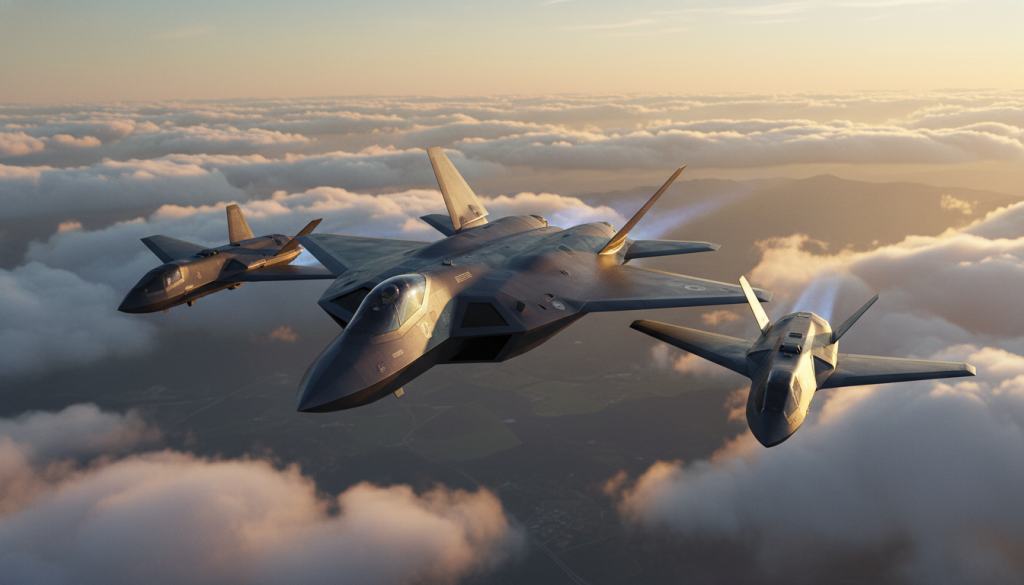
The silhouette of a lone fighter jet tearing through the clouds has long been the ultimate symbol of aerial supremacy. However, the future of aerospace dominance is rapidly moving away from the solitary maverick and toward a highly synchronized, networked swarm. As adversarial capabilities advance and the airspace becomes increasingly contested, modern militaries are fundamentally rethinking their approach to power projection. The answer lies in pairing human intuition with the relentless, calculating precision of machines. This paradigm shift is being driven by rapid advancements in autonomous aircraft, fundamentally altering the geometry of the battlefield and redefining what it means to take to the skies.
At the vanguard of this revolution is a concept that sounds like science fiction but is quickly becoming operational reality. Militaries are no longer relying solely on expensive, exquisite manned platforms that take decades to develop. Instead, they are distributing risk and capability across a dynamic network of manned and unmanned assets, creating a resilient architecture capable of overwhelming sophisticated air defense systems.
The Tactical Evolution of the Loyal Wingman
Central to this new doctrine is the “Loyal Wingman” concept. These are highly advanced, autonomous aircraft designed to fly alongside manned fighter jets, acting as force multipliers. Unlike traditional drones that require constant remote piloting, a Loyal Wingman operates with a high degree of independence. A single human pilot in a fifth-generation fighter can command a formation of these unmanned combat aerial vehicles (UCAVs), assigning them overarching mission objectives rather than micromanaging their flight paths.
The strategic value of these autonomous wingmen is immense. They can fly ahead of the manned formation to act as scouts, absorbing enemy radar waves and mapping out hostile surface-to-air missile sites. In heavily defended airspace, they can be utilized as sacrificial assets, drawing enemy fire to ensure the survival of the human pilot. Furthermore, they can be equipped with modular payloads, carrying extra munitions, advanced sensor pods, or jamming equipment. This flexibility allows commanders to tailor their strike packages to specific threats without risking irreplaceable human lives or multi-million-dollar airframes.
Agentic Intelligence: The Cognitive Core
The true breakthrough enabling this collaborative combat isn’t just aerodynamic design; it is the integration of Agentic Intelligence. Traditional automation relies on pre-programmed scripts and rigid if-then logic. Agentic Intelligence, however, empowers the autonomous aircraft to understand its environment, evaluate multiple courses of action, and execute complex tasks with goal-oriented autonomy. When a Loyal Wingman encounters an unexpected threat, its onboard AI does not simply wait for a human command; it autonomously maneuvers, deploys countermeasures, and recalculates its approach to achieve the mission objective.
This level of cognitive processing is particularly crucial in the realm of Electronic Warfare (EW). Modern combat zones are awash in invisible conflict, with adversaries constantly attempting to jam radar, spoof GPS, and sever communication links. An aircraft driven by Agentic Intelligence can rapidly analyze hostile electromagnetic signatures and autonomously shift frequencies or deploy localized jamming to protect the manned leader. By processing terabytes of sensor data at the edge, these AI-driven wingmen filter out the noise, presenting the human pilot only with actionable, critical intelligence.
Prototyping the Future with Digital Twins
Developing such sophisticated, interconnected systems requires a departure from traditional aerospace engineering timelines. To accelerate the deployment of autonomous wingmen, defense contractors are heavily leveraging Digital Twins. A Digital Twin is a hyper-realistic, highly accurate virtual replica of the physical aircraft and its onboard systems. Before a single piece of composite material is cut or a line of code is uploaded to a physical prototype, the aircraft flies millions of simulated hours in a virtual environment.
These simulations expose the Agentic Intelligence to countless combat scenarios, edge cases, and systemic failures. Engineers can tweak the aerodynamic profile, adjust the sensor fusion algorithms, and immediately observe how the changes impact the drone’s survivability and lethality. When the physical aircraft is finally manufactured, it is already a seasoned veteran of a million virtual wars. This digital-first approach drastically reduces development costs and ensures that the software governing these machines is robust, predictable, and trustworthy.
Orchestrating the Kill Web: Multi Domain Coordination
The integration of autonomous aircraft extends far beyond the immediate airspace. These platforms are vital nodes in a broader strategy of Multi Domain Coordination. In the next generation of warfare, operations in the air, on land, at sea, in space, and within the cyber realm must be seamlessly synchronized. A Loyal Wingman is not just communicating with its manned flight leader; it is constantly exchanging data with low earth orbit satellite constellations, naval destroyers, and ground-based radar installations.
This interconnected architecture creates a resilient “kill web” rather than a linear kill chain. If a satellite detects a hypersonic weapon launch, that data can be instantly relayed through secure satellite communications directly to an autonomous aircraft loitering in the vicinity. The drone can then autonomously position itself to intercept or jam the weapon’s guidance systems, all before a human commander at a distant base has fully processed the threat. This speed of information sharing and execution is the ultimate advantage in modern conflict.
As we stand on the precipice of this new era in aerospace operations, the role of the human aviator is undergoing a profound transformation. The fighter pilot of tomorrow will rely less on physical stick-and-rudder skills and more on their ability to manage complex networks, acting as a battlefield quarterback orchestrating a swarm of intelligent, autonomous assets. The skies will be populated by machines that think, adapt, and collaborate at machine speed, creating an intricate ballet of silicon and steel. Ultimately, the true power of this technological leap lies not in replacing human ingenuity, but in amplifying it to unprecedented levels, ensuring that those who command the skies do so with unparalleled situational awareness and overwhelming, synchronized force.