The Invisible Architects: How Agentic AI and Thermal Imaging Are Revolutionizing Landing Zone Autonomy
In the quiet hum of a pre-dawn sky, where the first light of morning barely kisses the horizon, a revolution is unfolding—one that is as silent as it is transformative. High above the earth, autonomous systems equipped with cutting-edge technology are redefining what it means to land with precision, safety, and intelligence. At the heart of this evolution lies the convergence of Agentic AI and thermal imaging, two forces that are not just complementing each other but are fundamentally reshaping the landscape of landing zone autonomy. This is not the future; it is the present, and it is unfolding in ways that were once confined to the realms of science fiction.
The Dawn of Agentic AI: Intelligence That Acts
Agentic AI is not your typical artificial intelligence. Unlike traditional AI, which operates within predefined parameters, Agentic AI is designed to act with a degree of autonomy, making decisions in real-time based on a dynamic understanding of its environment. It is AI with agency—capable of not just processing data but also initiating actions, adapting to unforeseen variables, and learning from outcomes. In the context of landing zone autonomy, this means an AI that doesn’t just follow a script but writes its own in real-time, responding to the unpredictable nature of the skies and the ground below.
Imagine a drone or an autonomous aerial vehicle (AAV) approaching a landing zone. The terrain is uneven, the weather is shifting, and obstacles—both static and dynamic—litter the landscape. A traditional AI might struggle to adapt, relying on pre-programmed responses that could be rendered obsolete by the slightest change in conditions. Agentic AI, however, thrives in this chaos. It continuously analyzes the environment, weighs risks, and adjusts its approach, ensuring that every landing is not just successful but optimized for safety and efficiency. This is intelligence that doesn’t just compute; it acts.
Thermal Imaging: Seeing the Unseen
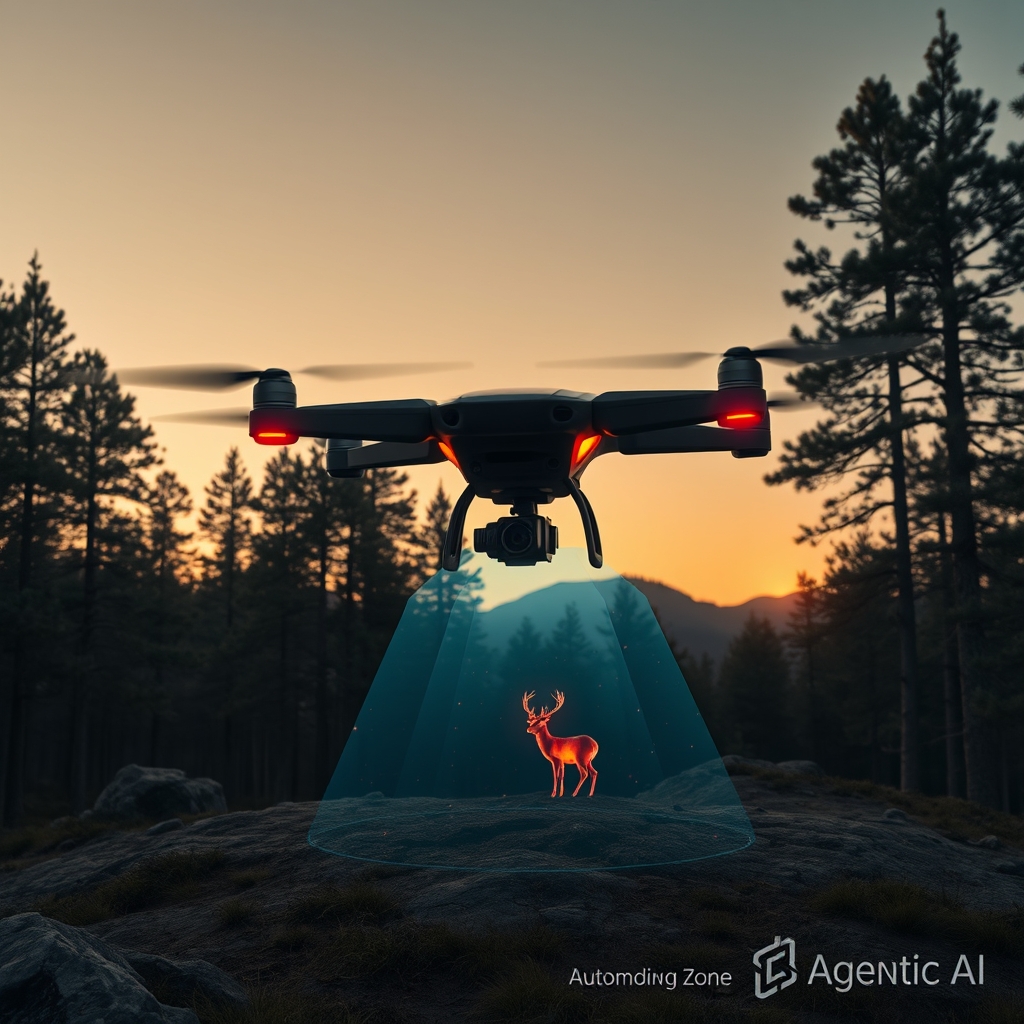
While Agentic AI provides the brain, thermal imaging offers the eyes—eyes that see beyond the visible spectrum, into a world of heat signatures and hidden details. Thermal imaging technology detects infrared radiation emitted by objects, creating a visual representation of temperature differences. In the context of landing zone autonomy, this is a game-changer. It allows autonomous systems to detect obstacles that might be invisible to traditional cameras, such as animals, humans, or even vehicles hidden in the shadows or obscured by foliage.
But thermal imaging does more than just reveal hidden obstacles. It provides a dynamic, real-time map of the landing zone, highlighting variations in terrain that could affect stability. For instance, a patch of ground that appears solid to the naked eye might be softer or more uneven than it seems, posing a risk to a landing aircraft. Thermal imaging can detect these nuances, allowing the Agentic AI to adjust its approach accordingly. It’s like giving the AI a sixth sense, one that sees the world in a way that human eyes never could.
The Synergy of Sight and Intelligence
The true power of this technological convergence lies in the synergy between Agentic AI and thermal imaging. Together, they create a system that is greater than the sum of its parts. The thermal imaging provides a constant stream of data, painting a detailed picture of the landing zone in real-time. The Agentic AI, in turn, processes this data, interprets it, and makes split-second decisions based on a nuanced understanding of the environment. This is not just automation; it is intelligent automation, where every decision is informed by a deep, dynamic analysis of the world.
Consider a scenario where an autonomous drone is tasked with delivering medical supplies to a remote, off-grid location. The landing zone is a small clearing in a dense forest, surrounded by trees and uneven terrain. As the drone descends, the thermal imaging system detects a heat signature near the landing site—a person, perhaps, or an animal that has wandered into the area. The Agentic AI immediately recalculates the landing parameters, adjusting the approach to avoid the obstacle while still ensuring a safe touchdown. This is not a hypothetical; it is a real-world application of these technologies, and it is already saving lives and improving efficiency in industries ranging from healthcare to logistics.
Beyond the Skies: The Broader Implications
The impact of Agentic AI and thermal imaging extends far beyond the realm of autonomous aerial vehicles. These technologies are finding applications in sectors as diverse as agriculture, search and rescue, and even space exploration. In precision agriculture, for example, drones equipped with thermal imaging and Agentic AI can monitor crop health, detect irrigation issues, and even identify pest infestations before they become visible to the human eye. The AI can then take action, such as adjusting irrigation systems or alerting farmers to potential problems, all without human intervention.
In search and rescue operations, these technologies are proving invaluable. Thermal imaging can detect the heat signatures of missing persons, even in dense forests or under rubble, while Agentic AI can coordinate multiple drones, optimizing their search patterns and ensuring that no area is left unexamined. The result is faster, more efficient rescues, with a higher likelihood of success. This is not just about improving existing processes; it is about redefining what is possible.
The Ethical Dimension: Navigating the New Frontier
As with any transformative technology, the rise of Agentic AI and thermal imaging brings with it a host of ethical considerations. The ability of these systems to operate autonomously raises questions about accountability, privacy, and the potential for misuse. Who is responsible if an autonomous drone makes a decision that leads to unintended consequences? How do we ensure that thermal imaging, which can see through walls and into private spaces, is used responsibly? These are not just theoretical questions; they are challenges that must be addressed as these technologies become more widespread.
One approach to navigating these ethical dilemmas is to embed principles of transparency and accountability into the design of these systems. Agentic AI should not operate as a black box; its decision-making processes should be explainable and subject to oversight. Similarly, the use of thermal imaging should be governed by strict regulations, ensuring that it is used only in contexts where it is necessary and appropriate. By addressing these issues proactively, we can harness the power of these technologies while minimizing their risks.
The Road Ahead: A World Transformed
The fusion of Agentic AI and thermal imaging is not just a technological advancement; it is a paradigm shift. It represents a move away from rigid, rule-based systems and toward intelligent, adaptive machines that can navigate the complexities of the real world. As these technologies continue to evolve, they will unlock new possibilities, from safer autonomous landings to more efficient agricultural practices and beyond. The skies are no longer the limit; they are the starting point for a new era of innovation, one where the invisible architects of Agentic AI and thermal imaging are reshaping the world in ways we are only beginning to imagine.
In the quiet of that pre-dawn sky, as the first light of morning illuminates the horizon, it is worth reflecting on the profound changes that are taking place. The technologies we once dreamed of are now a reality, and they are not just changing how we land or how we see the world—they are changing how we think about what is possible. The future is not something that happens to us; it is something we build, one intelligent decision at a time, guided by the unseen hands of innovation.